Protein powder has a marketing problem. Walk into any supplement store and you will find products promising extreme transformations, promoted by people whose results bear little resemblance to what most consumers can reasonably expect. That image has kept a lot of practical, sensible people away from something that is genuinely useful.
Protein powder is a convenient and efficient way to increase daily protein intake. Whether you are a busy parent, a teen athlete recovering from practice, or an older adult who struggles to eat enough, there are legitimate reasons to incorporate it. What follows is a straightforward guide to choosing the right one.
What Protein Powder Is and Is Not
Protein powder is a concentrated protein extracted from a food source, typically dairy (whey or casein), eggs, or plants (peas, rice, hemp, or soy). It is not a magic muscle supplement, a replacement for whole food, or a product reserved for bodybuilders. It is a practical tool for closing a protein gap in an otherwise reasonable diet.
The Main Types: What the Differences Mean for You
Whey Concentrate vs. Isolate: Which Is Better and for Whom
Whey is derived from milk, specifically the liquid byproduct of cheese production. It digests quickly and contains all the essential amino acids required for muscle repair.
- Whey concentrate is the foundational form, retaining some fat and lactose. It is typically less expensive and works well for most people without digestive sensitivities.
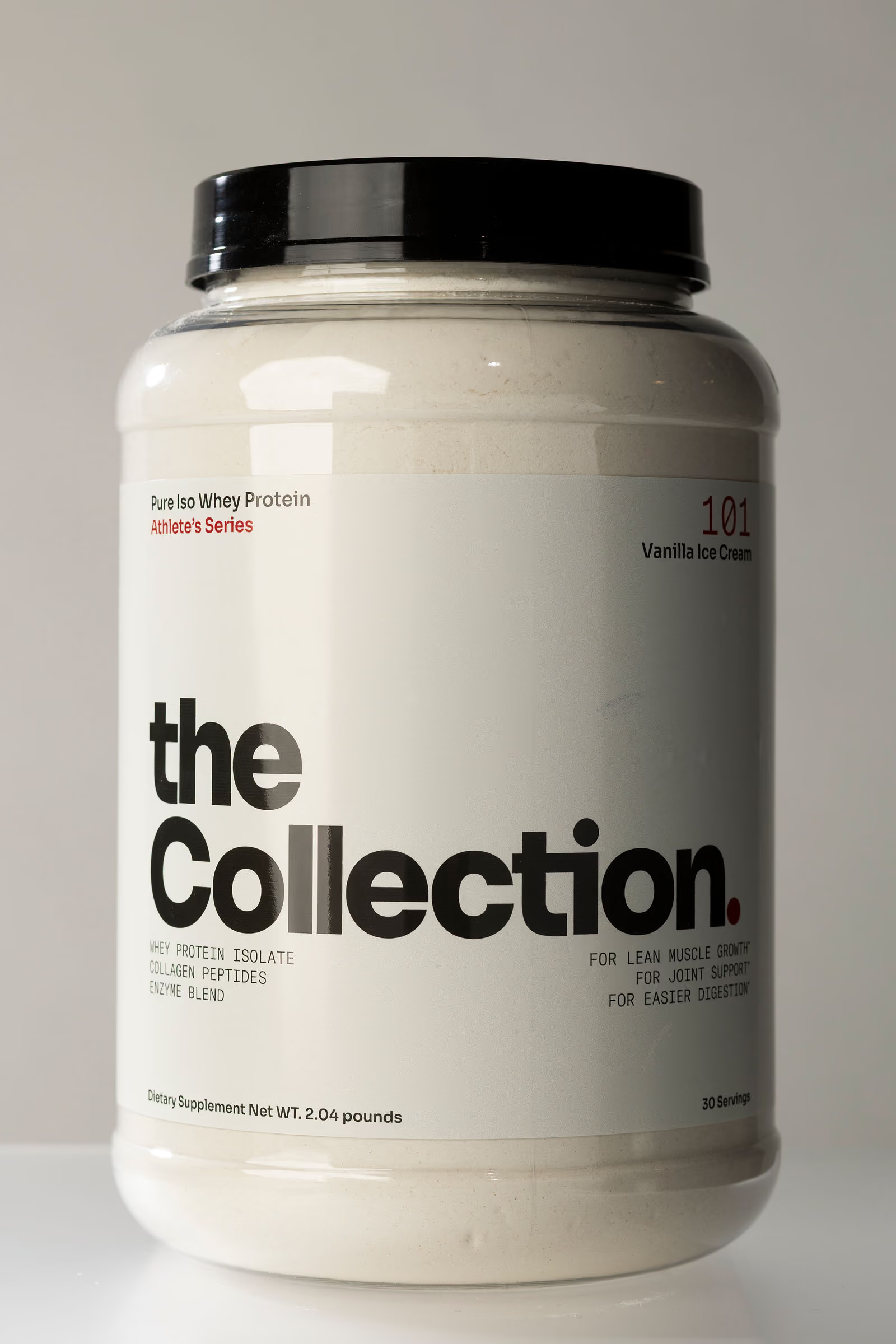
- Whey isolate has had most of the fat and lactose removed, resulting in a higher protein percentage per scoop, under 1% lactose, and faster digestion. For anyone who finds dairy difficult to tolerate, isolate is almost always better suited. Pure Iso Whey from The Collection uses whey isolate as its base, delivering 23.7g of protein per serving with essential amino acids that help whey isolate digest quickly. [8, 9]
Plant-Based Proteins and Who They Work Best For
Plant proteins, including pea, rice, hemp, and soy, have improved considerably over the past decade. Pea protein in particular has strong research backing and a solid amino acid profile. Plant proteins are well suited for vegans, those with dairy intolerance, or anyone who finds that whey is difficult to digest comfortably.
How Much Protein Do You Actually Need?
Protein requirements vary meaningfully by age, activity level, and goals. The International Society of Sports Nutrition’s position on protein and exercise provides the reference ranges below. [18]
- Sedentary adults: roughly 0.36 grams per pound of bodyweight per day
- Active adults (exercising 3 to 5 times per week): 0.64 to 0.91 grams per pound
- Athletes and heavy trainers: 0.7 to 1 gram per pound
- Teen athletes (still growing): approximately 0.6 to 0.8 grams per pound
- Adults over 60: protein needs increase with age, not decrease. The PROT-AGE Study Group, an international expert panel, recommends older adults consume meaningfully more protein than the standard adult RDA to maintain muscle mass and function. [35]
For anyone who exercises regularly without deliberately prioritizing protein at each meal, daily intake is likely falling short. Adding a single protein shake per day alongside normal food intake is generally sufficient to close that gap.
When to Take Protein Powder for the Best Results
Muscle tissue is responsive to protein in the hours following exercise, and consuming a serving shortly after training is a practical habit that works well for most people.
That said, it is worth being accurate about how much the exact timing matters. A meta-analysis published in the Journal of the International Society of Sports Nutrition examined protein timing across multiple studies and found that total daily protein intake was a far stronger predictor of strength and muscle gains than the precise window in which it was consumed. [37]
The practical takeaway is reassuring, particularly for busy families: sooner is better, but hitting your daily protein target consistently matters more than racing a stopwatch after practice.
Protein Is the Raw Material. Something Has to Tell Your Body to Use It.
Protein is the supply. It is not the instruction.
Inside every muscle cell there is a signaling pathway called mTOR. The simplest way to think about it is a switch that tells your body to take the amino acids circulating in your blood and turn them into muscle tissue rather than burning them for general upkeep. Hard training flips that switch on. When training stops, it settles back down.
This is the part most protein guides skip. You can hit your daily target perfectly and still leave results on the table if the building signal is not there to receive it. Delivering lumber to a job site does not put up a house. Somebody has to be working.
OptiNOs® is The Collection’s patented formula built around that switch. It combines three plant extracts, Cissus quadrangularis, Curcuma longa, and Trachyspermum ammi, selected after more than 300 herb combinations were tested for how well they work together. [7] It activates mTOR directly, which means the muscle-building signal is present even on days you do not train, and rest days are when muscle is actually built. It also raises nitric oxide production, which widens blood vessels so more of the protein you just drank reaches working muscle instead of circulating past it.
In a 6-week randomized, double-blind, placebo-controlled trial in physically active adults aged 20 to 50, OptiNOs® produced a 66 lb gain in bench press against 8 lb for placebo, and a 90 lb gain in leg press against 12 lb. Participants gained three times more lean muscle mass and twelve times the increase in arm circumference, with six times greater endurance and 140% faster lactic acid clearance. [3]
Muscle Builder Complex is the product built around it, pairing OptiNOs® with a 1,200mg nitric oxide complex. [9] It is not an alternative to protein powder and it does not replace one. Protein is what your body builds with. OptiNOs® is what tells it to build.
Red Flags on a Protein Label You Should Not Ignore
- Amino acid spiking: some brands inflate reported protein content by adding inexpensive amino acids such as glycine or taurine. Look for whey protein isolate listed as the named source, rather than a generic “protein blend.”
- High sugar content: some protein powders contain 15 to 25 grams of added sugar per serving, which is worth scrutinizing carefully.
- No amino acid breakdown: a quality product discloses its full amino acid profile so the consumer can evaluate what they are actually getting.
- No third-party testing: protein powders are among the most frequently adulterated categories in the supplement industry, making independent verification particularly important.
How Pure Iso Whey Fits Into a Real Daily Routine
Pure Iso Whey is a complete recovery formulation: 23.7g of whey isolate, 3g of collagen peptides for joint and connective tissue repair, 7g of fermented BCAAs, and a 200mg enzyme blend that begins breaking down the protein prior to digestion for faster absorption and improved tolerance. [8, 9] The collagen component is not filler, as collagen peptides are included to support connective tissue as a part of the recovery formula. [36]
Fermented BCAAs are produced through a significantly cleaner process than conventional BCAA powders, which are typically manufactured using harsh chemical extraction methods.
- For a teen athlete: one scoop mixed with water or milk after practice
- For a busy parent: one scoop in the morning when time does not allow for a full meal
- For an older adult: a daily shake that makes it straightforward to meet protein targets without requiring a large meal
Pairing Protein with Muscle Builder Complex
For anyone whose goal is specifically building size and strength rather than just meeting a daily protein target, Pure Iso Whey and Muscle Builder Complex are designed to work as a pair. The protein supplies the amino acids. OptiNOs® keeps the signal that puts them to use switched on between sessions. Take Muscle Builder Complex at the same time everyday, as consistency drives results. [9]
Disclaimer: These statements have not been evaluated by the Food and Drug Administration. This product is not intended to diagnose, treat, cure or prevent any disease.
Sources
- [3] Laila Nutraceuticals: OptiNOs® Strength & Body Composition Study (6-week RCT)
- [7] The Collection Science Education Platform, thecollectionbrand.com
- [8] The Collection Supplement Deep Dive, thecollectionbrand.com
- [9] The Collection Product Label Information, Earth’s Creation USA
- [18] Jäger R, et al. International Society of Sports Nutrition position stand: protein and exercise. Journal of the International Society of Sports Nutrition, 2017
- [35] Bauer J, Biolo G, Cederholm T, et al. Evidence-based recommendations for optimal dietary protein intake in older people: a position paper from the PROT-AGE Study Group. Journal of the American Medical Directors Association, 2013
- [36] Clark KL, Sebastianelli W, Flechsenhauer KR, et al. 24-week study on the use of collagen hydrolysate as a dietary supplement in athletes with activity-related joint pain. Current Medical Research and Opinion, 2008
- [37] Schoenfeld BJ, Aragon AA, Krieger JW. The effect of protein timing on muscle strength and hypertrophy: a meta-analysis. Journal of the International Society of Sports Nutrition, 2013