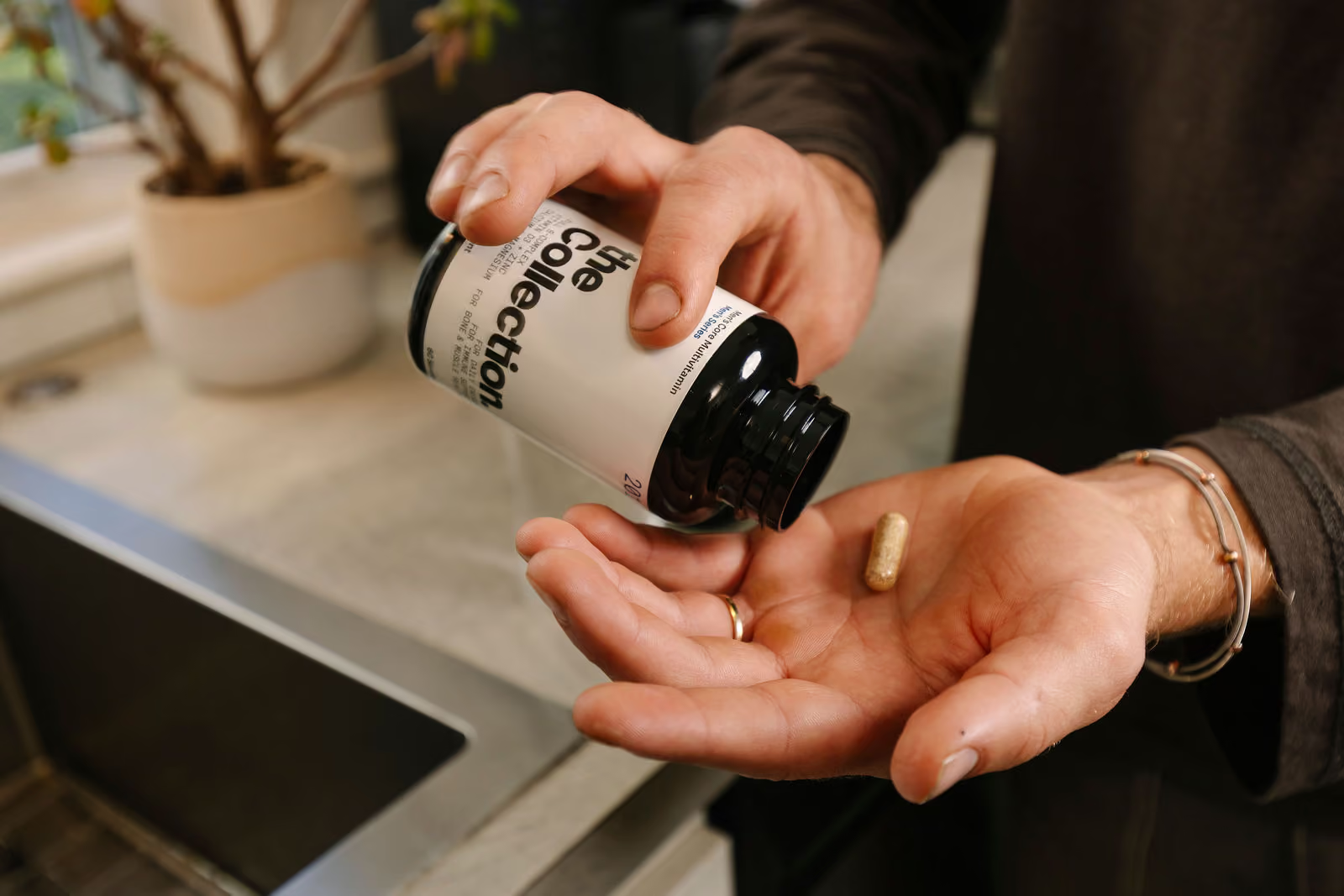
There is a right way and a wrong way to take supplements, and most people are doing at least one thing that is undermining their results without their awareness. This guide covers what helps, what hurts, and the one standard that applies at every age.
The Do’s: Habits That Make Your Supplements Work
Take Fat-Soluble Vitamins with a Meal That Has Dietary Fat
Vitamins A, D, E, and K require fat to be present in the digestive tract in order to absorb properly. [10] Taking them on an empty stomach with water alone is comparable to trying to dissolve butter in a glass of water. The effect has been measured: in a small study of 17 patients who moved a vitamin D dose to their largest meal of the day, blood levels rose by roughly 50%. [11]
Before taking these supplements, eat something that includes a fat source: eggs, avocado, peanut butter on toast, a handful of nuts, or full-fat yogurt. A large meal is not required; a small amount of fat is sufficient.
Pair Iron with Vitamin C to Increase Absorption
Iron absorption receives a meaningful boost when taken alongside vitamin C, which converts dietary iron into a more absorbable form and blocks compounds that would otherwise inhibit it. [34] Taking iron with a glass of orange juice, a handful of strawberries, or a vitamin C supplement is a simple and effective way to improve uptake. This is particularly relevant for women taking standalone iron supplements.
Be Consistent: Regularity Matters More Than Perfection
Think of supplements the way you would think about watering a garden. Watering every day, even imperfectly, produces better results than occasional perfect watering sessions. A supplement taken consistently every morning will do more over time than the most sophisticated formula taken sporadically.
Make Sure You Can Read the Label
A supplement label should clearly show what is in the product, how much of each ingredient is present, and in what form. The doses that matter most are the ones for the ingredients a product is actually sold on. If a formula is built around a specific ingredient and that ingredient’s dose is not on the label, there is no way to evaluate whether it is present at a therapeutically relevant level. CurQLife®, for example, discloses the exact doses of its patented components. Across The Collection, every ingredient is named and every patented ingredient carries its clinical dose, so you can verify what you are putting in your body against the research behind it. [5, 7, 9]
The Don’ts: Mistakes That Undercut Your Investment
Don’t Take Calcium and Iron at the Same Time
These two minerals compete for the same absorption pathway, an interaction documented across multiple human absorption studies. [16] Anyone taking standalone iron alongside a separate calcium supplement should separate them by at least two hours.
Don’t Assume More Is Better: Dosing Is Guided by Research, Not Marketing
Clinical doses are specific. Taking double the recommended amount does not produce double the effect, and for some supplements, higher doses can produce unwanted side effects without any added benefit. This is particularly true for fat-soluble vitamins, which the body stores rather than excretes, allowing them to accumulate over time. [10] The Collection uses the exact clinical doses drawn from credible published research.
Don’t Buy a Product Whose Main Ingredient Has No Dose
If a product is marketed on a specific ingredient, that ingredient’s dose belongs on the label. When it is not there, you are buying a name rather than a formula, and there is no way to know whether it is present at a level that produces a meaningful effect. This is worth checking before anything else, because no other quality signal matters if the main ingredient is underdosed.
Do’s and Don’ts When Supplementing Kids vs. Adults
Do Adjust the Dose: Kids Are Not Small Adults
Most adult supplements are formulated for an adult’s body, not a child’s. Kid-specific formulations exist for substantive reasons and should always be the default for children.
Do Choose Kid-Specific Formulations and Know What to Look for on the Label
For children, look for age-appropriate dosing, no high-dose stimulants, fully disclosed ingredients, and third-party testing verification. Focus Fuel from The Collection is a clinically studied supplement that is caffeine-free, chewable, and formulated specifically for ages 6 and up. [2]
Do Prioritize Foundational Nutrients Before Performance-Focused Supplements
For children, a multivitamin, vitamin D, omega-3s, and adequate protein are the essential building blocks of a strong nutritional foundation. That foundation should be established first, with performance-focused supplements introduced much later, at mid-to-late high school at the earliest.
Don’t Give Teenagers Adult Pre-Workouts or Stimulant-Heavy Formulas
A developing nervous system responds differently to high-dose stimulants, with a higher risk of anxiety, elevated heart rate, and sleep disruption. The American Academy of Pediatrics has advised that stimulant-containing energy products have no appropriate place in the diets of children and adolescents. [20] Non-Stim Pre-Workout from The Collection is the appropriate choice for teen athletes. It includes clinical blood flow support, BacoZest™ for focus, and zero caffeine, while supporting energized workouts and proper recovery.
Don’t Skip the Conversation: Kids Who Understand Why They Are Taking Something Are More Likely to Stay Consistent
A child who understands that a supplement helps their brain retain information and sustain focus is considerably more likely to take it consistently than one who was handed something without context or explanation.
The One Thing That Does Not Change at Any Age
Whether purchasing for a 9-year-old or a 75-year-old, the standard remains the same: every ingredient named, and every clinically studied ingredient at the dose the research used. Transparency is not a feature reserved for a specific age group or product line. It is the baseline.
How The Collection Is Built Around Every One of These Principles
The do’s and don’ts in this guide reflect the same principles behind every formulation decision at The Collection: patented ingredients at doses that match the published research, full ingredient transparency, and age-appropriate formulations across every series.
Disclaimer: These statements have not been evaluated by the Food and Drug Administration. This product is not intended to diagnose, treat, cure or prevent any disease.
Sources
- [2] Laila Nutraceuticals: BacoZest™ Children’s Study (84-day GCP RCT, n=40)
- [5] Laila Nutraceuticals: CurQLife® In Vitro Cell Studies
- [7] The Collection Science Education Platform, thecollectionbrand.com
- [9] The Collection Product Label Information, Earth’s Creation USA
- [10] Andrès E, et al. Fat-Soluble Vitamins A, D, E, and K. Journal of Clinical Medicine, 2024
- [11] Mulligan GB, Licata A. Taking vitamin D with the largest meal improves absorption. Journal of Bone and Mineral Research, 2010
- [16] Hallberg L, et al. Calcium and iron absorption. European Journal of Clinical Nutrition, 1992
- [20] American Academy of Pediatrics, Committee on Nutrition and Council on Sports Medicine and Fitness. Sports drinks and energy drinks for children and adolescents: are they appropriate? Pediatrics, 2011
- [34] Teucher B, Olivares M, Cori H. Enhancers of iron absorption: ascorbic acid and other organic acids. International Journal for Vitamin and Nutrition Research, 2004